




Automation of the fixed assets inventory
Fixed asset inventory originally emerged as a concept in accounting. Today, however, the scope of the term has expanded significantly and now refers to comprehensive enterprise asset management. In the past, fixed asset inventory meant verifying that physical assets matched accounting records in journals and software systems. Today, it includes a much deeper level of tracking, identification, and control of company assets.
Fixed assets are tangible resources (tools, equipment, machinery, etc.) used in production or service delivery with a useful life exceeding one year. To ensure that actual assets correspond to accounting records, companies must periodically conduct inventory checks. Traditionally, this involves manual counting, which is time-consuming and labor-intensive.
We offer a modern approach to fixed asset inventory that significantly simplifies and accelerates this process.
Labeling
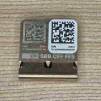
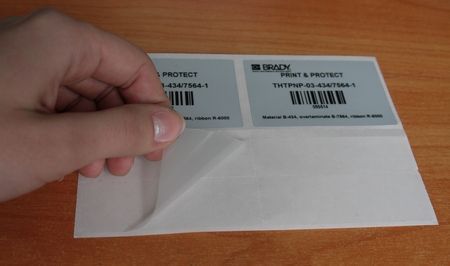
To conduct inventory efficiently, all fixed assets must be properly labeled. We propose a simple and modern labeling method: printing barcode labels using a label printer. These labels contain a barcode with the asset name, inventory number, and location.
The use of a thermal transfer printer together with polypropylene labels and the appropriate ribbon allows coverage of up to 80% of labeling needs for office equipment and assets.
For production environments and outdoor equipment, specialized industrial labels or alternative marking solutions are required.

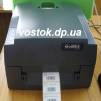
One of the optimal entry-level models for starting an inventory project is the Godex G500 label printer. It integrates easily with corporate software systems, is not demanding in terms of consumables, and is easy for staff to operate.
Printed labels are applied using a manual label applicator, which ensures fast and effortless application.

For certain types of equipment and machinery, standard paper or synthetic labels may not be sufficient. In industrial workshops, outdoor areas, warehouses, or maintenance operations, labels are exposed to moisture, dust, oils, UV radiation, temperature fluctuations, and mechanical abrasion. In such environments, the optimal solution is laminated labels — featuring an additional protective layer that safeguards both the print and the label material.
The lamination layer ensures resistance to aggressive environments, chemicals, frequent handling, and tool contact. This is especially important for inventory numbers, technical data, QR codes, barcodes, and RFID tags that must remain readable throughout the entire asset lifecycle — from commissioning to disposal. Code integrity and readability directly affect the quality of accounting, maintenance, repairs, and audits.
Using specialized laminated labels reduces re-labeling costs, increases the reliability of automatic identification, and ensures compliance with internal or industry standards. In asset automation projects, such labeling is not merely a consumable but a key infrastructure element of the asset management system.
Integrating inventory automation into existing corporate accounting systems requires a preliminary analysis of the enterprise IT architecture. It is necessary to evaluate database structures, accounting platforms, data exchange regulations, and information security requirements before selecting the optimal integration model.
Common integration approaches include structured file exchange (scheduled imports/exports), API-based real-time or near real-time integration, and direct database synchronization services. The choice depends on enterprise scale, data update requirements, system load tolerance, and internal security policies.
A properly selected integration model eliminates data duplication, minimizes manual operations, and prevents version conflicts. As a result, inventory automation becomes an integral part of the unified corporate information management system.

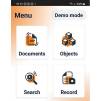
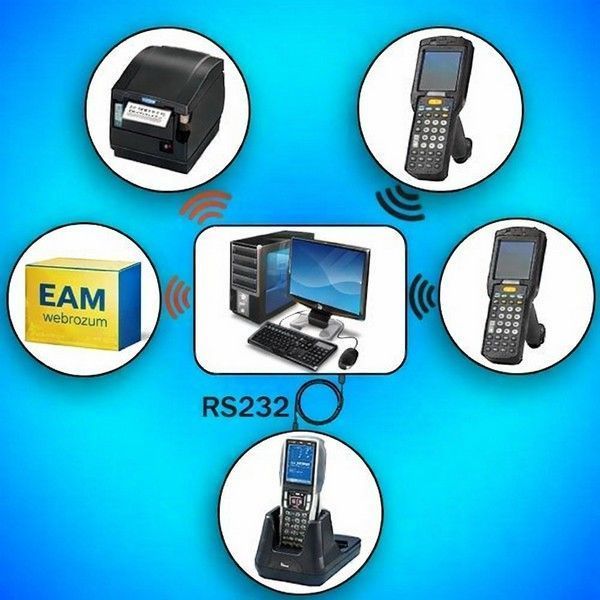
When it is time to conduct inventory, the process becomes simple. Using a mobile data terminal, employees scan all barcodes applied to fixed assets.
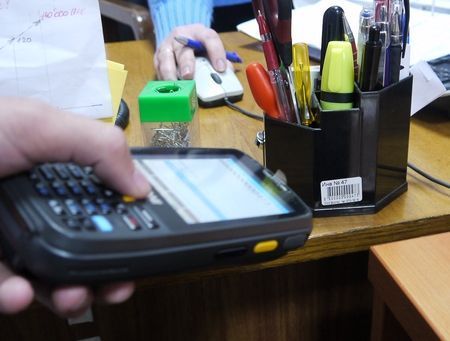
The collected data is then uploaded to the system by connecting the terminal to a PC. Inventory results are obtained instantly by comparing scanned data with existing records.
Inventory can also be performed remotely in company branches located in other cities. After scanning assets in a branch, data can be transmitted via the Internet directly to the central office database. This ensures that branch staff cannot modify inventory results, increasing transparency and reliability.
This approach significantly improves efficiency and accuracy, reduces human error, and lowers labor costs.
Contact Vostok to automate your fixed asset inventory process. Send your request and questions to vostok@pkf.dp.ua, via the feedback form, or call +38 068 405-41-11.
Products